

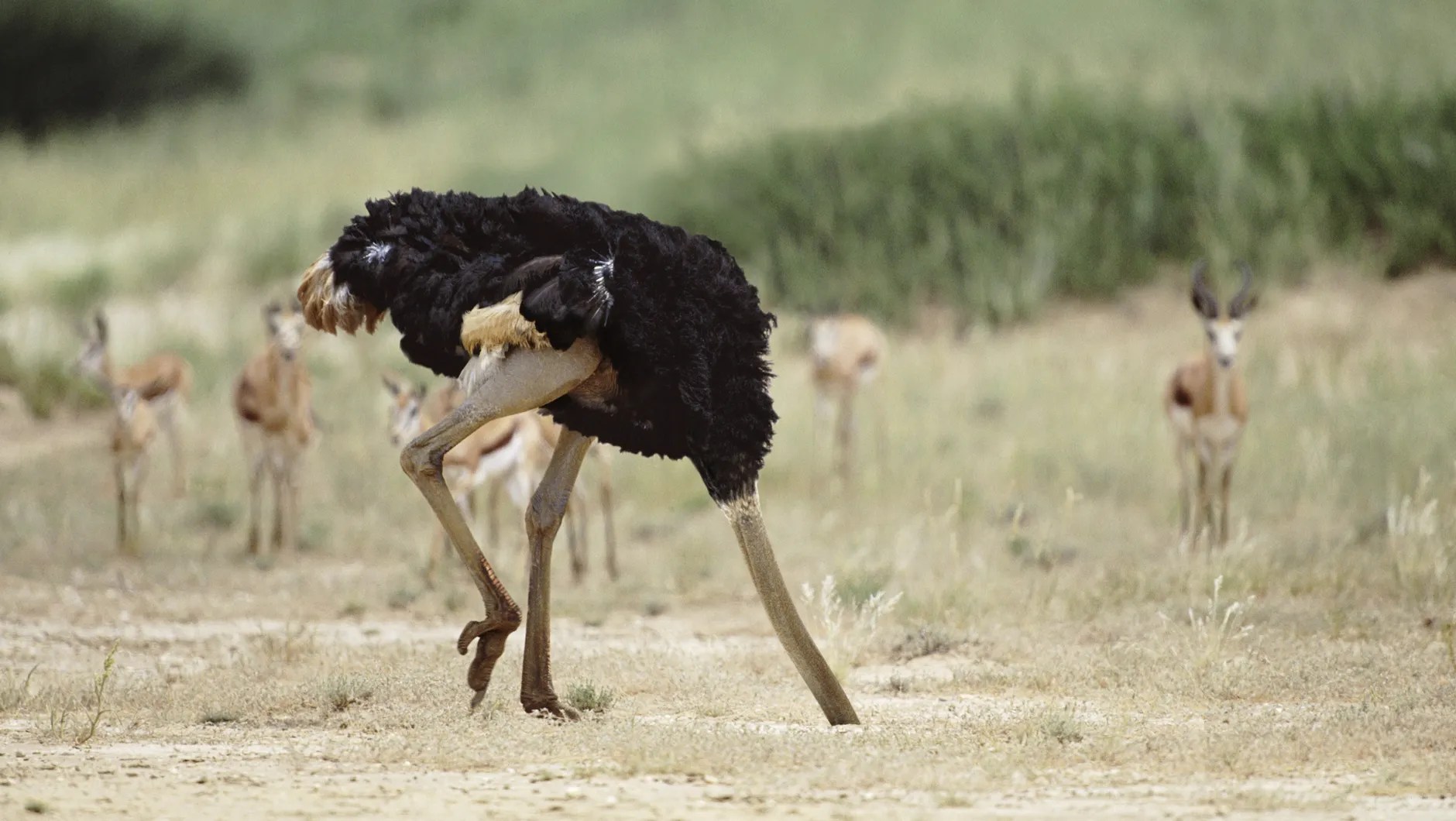
(No, not exactly, because ostriches don’t bury their heads in the sand to hide or ignore, but to check on, and rotate, the eggs that they’ve laid there.)
It’s been a long two weeks. Actually, it’s been less than two weeks since inauguration day, though it feels like much longer. Certainly, the quantity of news related articles I’ve read in the last eleven days totals what I normally read in a month or month-and-a-half, maybe two if I’m in a tired-of-news-phase, which does happen.
When I was younger, I found the news to be rather dull. I did not understand how anyone could ever bear to watch people discuss what was going on somewhere on the other side of the country, across the world, or even around town. I was far more enchanted by the contents of my imagination, or the contents of books, movies, and the after-school television programming, especially on Fridays. I don’t really remember when I started to take interest in the news. Probably around the time Obama came about. He got my attention, though not for long. But then I moved to Ecuador and proceeded to live there for two years. That might have been when news became a bit more interesting: not only to learn about what was going on in this country I knew so little about, but what was going on at home, in the country I was surprised I missed so deeply, even though I was also learning much about America that made my cheeks burn with shame.
But once I started paying attention to the news, I found it hard to stop. Suddenly, it seemed both important and interesting (the shock!) to have some clue as to what was going on in my city, my state, my country, and yes, even around the planet. Of course, no person can digest every bit of news going on everywhere, but we can choose a few topics that feel especially important to us, and follow those.
Why is it important to have one’s finger on at least an occasional pulse of reality? Because we live in reality. And reality is a vast, complicated tapestry, and we are the fibers that compose the threads—and how we move (or don’t move) pulls on that fabric. What we do can reinforce tearing, or twisting, bunching, unraveling. More concretely: we live in the present, which is the future’s history, and it’s not written yet. We can still influence it, move it, stretch it, even if only slightly. At the very least, we can watch it as it unfolds, as it’s written.
I won’t deny that watching or reading the news right now can be uncomfortable, it certainly can be, but ignoring it or burying our heads in the sand isn’t going to make any of it go away. And it certainly isn’t going to help things get better. What I’m personally struggling with right now are two things: quantity (I do NOT need to be reading or watching as much news as I am, and must cut back for my own sanity, and health/sleep), and the feeling of helplessness, which I think in part fuels the excessive consumption of news: if I can’t do anything about all this, I might as well learn as much qs possible about what’s going on! It gives me a false sense of control, I think. But perhaps for others, feeling helpless might have the inverse effect: if I can’t do anything about all this terrible stuff, why bother exposing myself to it? It’ll just anger/depress/frighten me. Here’s my answer: because I don’t think the sensation (or actuality) of helplessness is going to last forever, and when the time comes to act, to do something, it’s going to be much harder to move if we don’t know where we are, if we haven’t been paying attention or lack awareness about what’s going on around us. Knowledge is power, in the right hands, at the right time.
Watching the news right now can be flabbergasting, shocking, painful, depressing, horrifying, frightening, and uncomfortable… but most of us live pretty comfortable lives, and won’t die if we expose ourselves to a bit more discomfort. We can handle it. In fact, we have to handle it if we stand any chance at, somehow, defeating Donald Trump and the ideologies that are gaining strength around him. I mean, last year I read a nonfiction book about the Dustbowl, and felt so absurdly comfortable curled up on my (at the time, pretty uncomfortable) couch, reading about people living in dugouts blown through with cold wind and dust and smoke, dirt on everything, in everything, even under one’s eyelids. I read about having to shit in a bowl in your hut because the wind was too strong to withstand walking to an outhouse. I also read a book about the Donner party, sleeping in wet and frozen clothes and electing to eat the corpses of those in their party who had perished to prevent starvation. I read about men lost at sea after their whale ship sunk, blistering in the sun as they floated in a small boat, and resorting to the same. Actually, no—they elected to shoot someone to eat, instead of allowing everyone starve to death. And let’s not forget about the immense levels of suffering and destruction going on around the world today, right now, this very second.
People, we have it pretty good, pretty easy, with our heated houses, furniture, and bright blue screens brimming with information and potential knowledge (I know I’m making some assumptions here, but please forgive me). Humans can withstand a lot, obviously, and we can certainly withstand pulling our heads out of the sand and paying closer attention to what’s going on in our country. We can be witness to history writing itself, we can perhaps even lend a hand in writing it, or we can turn our backs to it, waiting for something to be over. But we’ve already made that mistake: this movement isn’t just going to end. Ending it will require the active participation of everyone who opposes it. And who knows how long that could take.
Most of us can bear to squeeze in ten minutes of news a day. The more we read (or watch/listen) about the fate our our nation, our planet, the more tolerance we build for any discomfort this may initially bring. And then? It’s not so bad. It’s a good habit of awareness (unless you turn into me, a news gobbling machine who needs to, quickly, go on a strict diet!)
I was just watching Brooks and Capeheart, a ten minute segment that runs every Friday on PBS’s Newshour, another show I forgot to list in the last post that I sometimes enjoy (it’s also available to watch on YouTube and as an audio-only podcast). And since the Trump administration is electing to “investigate” NPR and PBS, now might be a good idea to support them! Right-wing folks I know insist NPR is “radical left”, but they’ve always felt pretty centrist to me (with a few exceptions), and the occasional leftward lean I detect is minimal. Another gem I’ve recently discovered for quick coverage of key issues is “The Warning” by Steve Schmidt (also available as an audio-only podcast). He was a campaign strategist for GW Bush, Schwarzenegger, and McCain, and then in 2016 became an independent, and then in 2020, and registered democrat. This means his views are a little unorthodox, and unpredictable, but, I tend to prefer listening to people who I can’t predict on every issue—I find their views are more rooted in their values instead of party orthodoxy, and they’re not afraid to say things that others are. Anyway, Time Magazine described Schmidt in 2008 as the “lord of outrage.” And having listened to several of his clips, I’m inclined to agree. He’s intense, but I like his level of outrage—it keeps me honest, on my toes, accountable.
Because we’re all a part of this. And where it goes.
 wildmind.space
Leave a comment